


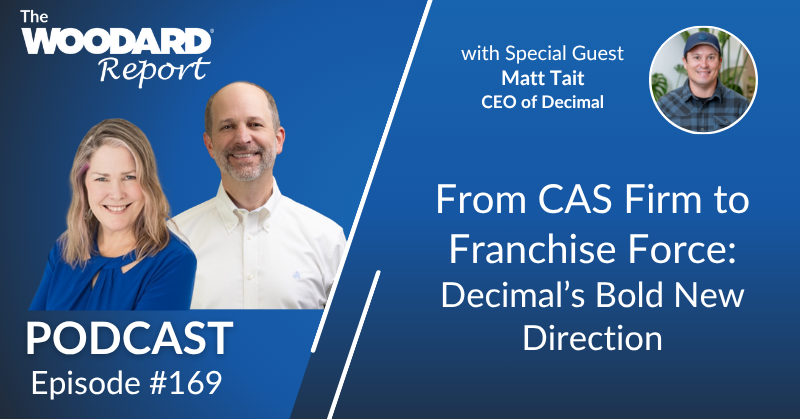

In episode 169 of the Woodard Report Podcast, Joe Woodard spoke with Matt Tait, CEO and co-founder of Decimal, about a major shift in the company’s direction. A longtime entrepreneur who previously launched two technology companies, Matt has built his career around helping businesses operate more effectively while creating strong customer experiences. That same people first, technology-enabled mindset shaped Decimal from the beginning.
After building a nationally recognized client advisory services practice, Decimal has now sold its direct services business and is focusing fully on helping other firm owners build stronger firms.
The conversation centered on a challenge many accounting professionals know well. A lot of firm owners want to lead a business, but they remain buried in the day-to-day work instead.
Watch Episode 169 here
How Decimal started
Matt explained that Decimal began in January 2020 with a clear goal. He wanted to build a better bookkeeping and CAS model after struggling with the accounting side of his own businesses. From the start, Decimal was building more than a service firm. It was also building an operating system made up of labor, systems, processes, and technology.
Decimal grew through acquisitions and developed a structure designed to scale. Along the way, Matt said the company learned something important about what clients actually want. Firms may sell themselves as tech-enabled, but clients are not really buying technology. As Matt said, “What they’re buying is trust, credibility, and accountability.”
That point shaped the firm’s approach. The work had to be accurate and consistent, but the relationship remained the real differentiator.
Why the firm changed direction
The biggest news in the episode was Decimal’s pivot into franchising. Matt said the company had already started moving this way and then chose to go all in. “We are entirely an empowerment company now.”
Joe pressed on that decision because Decimal appeared to be in a strong position as a modern CAS practice. Matt said the answer came down to impact. Decimal had helped more than 1,000 clients directly, but helping 1,000 firms each serve 100 businesses would create a much larger result.
He also pointed to the reality that many firm owners face. They are capable, busy, and in demand, but they feel trapped inside the business they built. Matt shared the story of a firm owner who told him she had never taken a spring break with her children and feared she never would. He said his goal was simple. Help her build a business that lets her take that break without bringing her computer.
What Decimal now offers
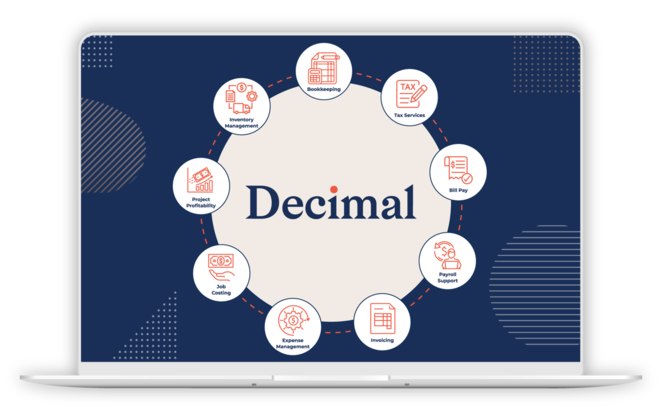
Joe asked Matt to explain what the Decimal operating system looks like in practice. Matt said it starts with playbooks, training, and systems. It also includes technology infrastructure, staffing support, community, and AI tools.
One example is an AI pricing agent that helps firm owners think through what to offer a prospect and how to price the work. Matt also said Decimal helps with recruiting in both the Philippines and the United States, billing, back office support, and labor for bookkeeping and close work. He described it as “everything necessary to run a firm.”
The model also includes community. Franchise owners are already referring work to one another based on specialty, which gives firms access to broader capabilities without building every service line on their own.
Who this is for
Matt said the model is built for two kinds of people. The first is the professional who wants to start a firm without building every system from scratch. The second is the existing firm owner who feels stuck and wants to transform the business into something more scalable and sustainable.
That point resonated with Joe, who reflected on years of coaching firms. Some are able to self-implement and grow independently. Others want the same result but never quite get there because life, complexity, or limited capacity keep getting in the way.
What it means for the profession
The conversation ended with a broader look at the accounting profession. Matt said the industry is entering a period shaped by AI, consolidation, and private equity. Larger firms will likely keep getting larger, and many middle-market firms may disappear into acquisitions.
At the same time, more professionals may decide to start their own firms. Matt sees that as part of Decimal’s opportunity. There is still a strong need for firms that can serve businesses in the $1 million to $10 million revenue range, especially those that are too large for retail bookkeeping models and too small for large enterprise firms.
Near the end of the episode, Joe described Decimal’s model as “people systems process in a box.” Matt agreed and said the goal is to make it easier for firm owners to succeed.
This episode offered a clear look at one possible path forward for firms that want more than growth for growth’s sake. Decimal’s new direction is built around a simple idea. Give more firm owners strong systems, better support, and room to focus on client trust and advisory work, and more firms can thrive.
Listen to the full episode and subscribe to The Woodard Report Podcast
🎧 Listen to the full episode at woodard.com/podcast.
Enjoyed this episode? Subscribe to The Woodard Report Podcast on your favorite platform for weekly insights that move your practice—and your life—forward.





Thank you to our show sponsor, Zoho!
Zoho is a unique and powerful software suite to transform the way you work, designed for businesses of all sizes, built by a company that values your privacy. For more information about Zoho, please visit woodard.com/podcast.
This article was written with the assistance of AI and edited by a human.






Do you have questions about this article? Email us and let us know > info@woodard.com
Comments: