


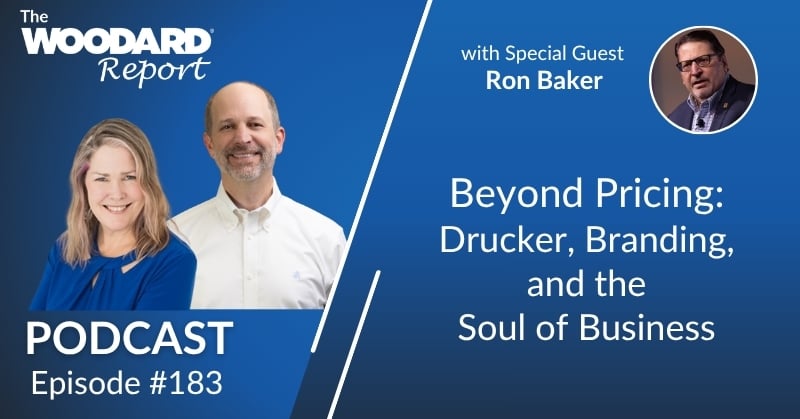

In episode 183 of The Woodard Report Podcast, Joe Woodard sits down with Ron Baker to discuss several topics that go beyond his well-known work on pricing. Ron Baker is the co-founder of Threshold, co-host of The Soul of Enterprise podcast and the author of eight books, including Firm of the Future, Implementing Value Pricing and Time’s Up.
Joe begins this episode by acknowledging that Ron is often introduced as the pricing expert. Pricing remains an important part of his work, but in this episode, Joe explores a few of the broader ideas that have influenced his thinking.
Their discussion moves through three main areas. Joe asks Ron about Peter Drucker’s influence on his work, the changing roles the accounting profession and Ron’s decision to regularly invite members of the clergy onto a business podcast.
Knowledge workers and the quality of work
Joe first asks Ron to choose three of Peter Drucker’s teachings that have had the greatest impact on him.
Ron first encountered Drucker’s work at the beginning of his career and began reading as much of his work as he could find. The first idea Ron discusses is Drucker’s description of the knowledge economy and the knowledge worker. Unlike industrial work, knowledge work depends primarily on thought, judgment, and experience.
Accounting professionals may follow systems and repeat certain processes, but the quality of their work cannot always be judged by watching how quickly they complete a task. As Ron explains, “Somebody sitting there on their computer can look like they’re incredibly efficient and the output, the results of their work could be very, very substandard.”
Joe presses Ron on what it means to say that knowledge workers own the means of production. Ron contrasts knowledge workers with factory employees who depend on the employer’s machinery and production line. A knowledge worker’s primary resource remains in their own mind. “My knowledge goes with me wherever I go.”
The discussion then moves into the idea that knowledge workers are volunteers in a practical sense. Their employer can require attendance and set expectations, but commitment and discretionary effort cannot be forced.
Ron connects that to purpose. He suggests that some professionals may experience moral injury rather than ordinary burnout and that burnout can come from a mismatch between resources and demands. Moral injury is what develops when professionals feel unable to live according to the purpose or obligations of their profession.
Watch Episode 183 here
Efficiency vs effectiveness
Ron’s second major Drucker influence is the distinction between efficiency and effectiveness. Drucker described efficiency as doing things right and effectiveness as doing the right things. Ron agrees with Drucker’s definition of effectiveness, but he challenges the definition of efficiency.
Efficiency, in Ron’s view, is simply a mathematical ratio of output to input. It does not tell us whether the work was worthwhile or whether the result was good. “We can be totally efficient at doing the wrong thing, which just makes everything worse.”
Joe and Ron spend a significant portion of the episode working through examples. Ron points to the Golden Gate Bridge. A cheaper and more practical structure might have served the same basic function, but it wouldn't be a symbol of a city that attracts people.
Ron applies the same reasoning to professional work. “I don’t want an efficient heart surgeon. I want an effective heart surgeon.”
In an accounting practice, a faster process does not automatically lead to better advice. A dashboard with more measurements does not necessarily help a client make a better decision. Practice leaders still have to decide which results matter and whether their systems are helping produce them.
Results happen outside the practice
Ron’s third Drucker concept is the marketing concept. Drucker believed that the results of an organization take place outside its walls.
Ron gives several examples. The result of a hospital is a cured patient, a school is an educated child and a church is a saved soul. The activity happening inside the organization matters because of what it produces for the people outside it.
Drucker also believed the purpose of a business was to create a customer. Ron explains that marketing and innovation are the only two business functions that produce results. Everything else represents effort or cost.
The same idea applies to an accounting practice. Completing a tax return, preparing a report or finishing a reconciliation may be necessary, but the internal activity is not the final result. The result is what the work allows the client to understand, decide, or accomplish.
Planned abandonment and future opportunities
Ron offers another Drucker teaching. The idea is planned abandonment. Drucker encouraged business leaders to ask whether they would enter a particular market, serve a certain customer or offer a specific service if they were making that decision today. A negative answer means the organization needs to decide what to do next.
Practices can become tied to services and client relationships that made sense several years ago but no longer support their direction. Ron explains that companies often spend too much time solving yesterday’s problems and not enough time pursuing future opportunities.
What faith leaders can teach business professionals
Joe’s final question focuses on Ron’s own podcast, The Soul of Enterprise. Ron and co-host Ed Kless have interviewed priests, a rabbi and members of other faith traditions, even though the podcast primarily serves a business audience.
Ron says the reason is partly contained in the show. Religious leaders and philosophers often have language for areas that standard management discussions overlook. They talk about dignity, stewardship, vocation, forgiveness, and human flourishing.
Ron says, “Business is a serious moral enterprise," and he sees practical connections between a leader’s beliefs, the way employees are treated and the value a company creates for customers.
Ron also discusses what he learned from Rabbi Daniel Lapin, including the idea that people are defined more by what they believe than by what they know. A person’s education or occupation tells us something about them, but their beliefs reveal more about how they will behave and make decisions.
Rethinking work and the value it creates
Joe and Ron cover a wide range of ideas, but each one comes back to how professionals think about their work and the value it creates. Drucker’s concepts offer a useful way to examine knowledge work, effectiveness, customer results, and the services a practice may need to reconsider. Ron’s final thoughts on belief and purpose add another perspective to the way business leaders make decisions and understand their responsibilities.
Listen to the full episode and subscribe to The Woodard Report Podcast
🎧 Listen to the full episode at woodard.com/podcast.
Enjoyed this episode? Subscribe to The Woodard Report Podcast on your favorite platform for weekly insights that move your practice—and your life—forward.





Thank you to our show sponsor, Puzzle!
The next generation firm, AI-powered human lead. Puzzle replaces manual QuickBooks workflows with AI-driven books built for review, approval, and audit-ready accountability. Learn more at puzzle.io..
This article was written with the assistance of AI and edited by a human.






Do you have questions about this article? Email us and let us know > info@woodard.com
Comments: