


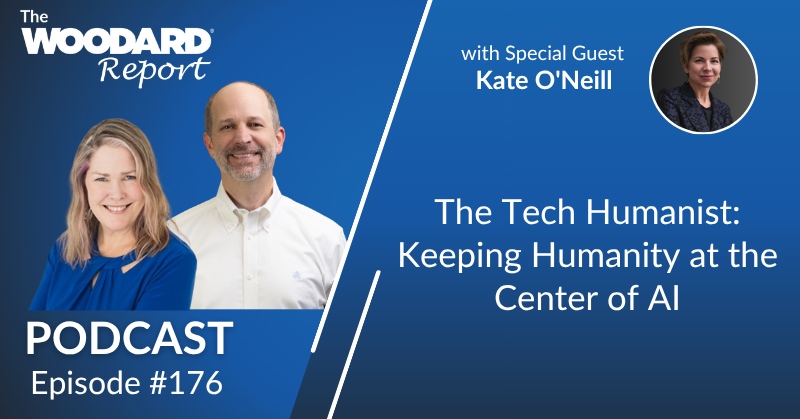

In episode 176 of The Woodard Report Podcast , Joe Woodard sits down with author, speaker, and technology strategist Kate O’Neill to explore a question that is becoming increasingly important in the age of artificial intelligence: How do we ensure technology serves humanity instead of diminishing it?
Known as “The Tech Humanist” the founder of KO Insights and author of What Matters Next, Kate has spent decades helping organizations navigate the intersection of technology and human experience. Their conversation examines everything from Disney’s customer experience strategy to the future of accounting, offering a thoughtful framework for professionals who want to embrace innovation without losing sight of what makes them valuable.
Technology should amplify purpose, not replace it
Joe begins by asking Kate about the philosophy behind her work and her book The Tech Humanist. Kate explains that technology should never be viewed as an end in itself. Instead, organizations should start with purpose and use technology to support meaningful outcomes. “Purpose, it turns out, is the shape that meaning takes inside business.”
Kate feels that businesses often focus on efficiency, automation, and profit while overlooking the deeper question of what matters most to the people they serve. Technology, when used thoughtfully, can help organizations align business objectives with human outcomes.
.jpg?width=598&height=337&name=TWR%20tech%20humanist%20(2).jpg)
Watch Episode 176 here
The Disney lesson
The conversation turns to Disney, an organization both Joe and Kate reference as an example of purpose-driven decision-making.
Joe points to Disney’s mission of creating happiness and explains how that purpose informs everything from customer service to operations. Kate notes that technology can actually strengthen that mission when it is designed to support the customer experience.
Using Disney’s MagicBand technology as an example, she explains that data and automation can create smoother, more personalized experiences while still reinforcing the company's core purpose.
Why human connection still matters
As organizations automate more processes, Kate cautions against assuming that efficiency is always the primary goal. Drawing on research into conversational AI and customer service interactions, she notes that people often prefer automation for simple transactional tasks, such as resetting a password or checking account information.
However, when situations become more complex or emotionally significant, people still want human interaction. “If there's anything that has something to do with emotional sophistication... my experience is going to be improved by someone demonstrating empathy and an understanding with me.”
The future of accounting is more human, not less
Joe raises a concern shared by many professionals in the accounting industry: what happens when the work people love becomes automated?
Many accountants entered the profession because they enjoy the precision, structure, and analytical nature of the work. As AI takes over more transactional tasks, some fear they may lose the aspects of accounting they value most.
Kate encourages listeners to look beneath the mechanics of the work and focus on the context surrounding it. “I would invite people to consider the possibility that there's a nuance to it that was always a little bit hidden beneath that transactional work.”
Rather than eliminating the need for accountants, automation may create opportunities for professionals to spend more time helping clients understand patterns, evaluate tradeoffs, and make strategic decisions.
Wisdom, judgment, and trust
Throughout the conversation, Kate returns to the idea that technology excels at identifying patterns but struggles to replicate human experience. While AI may eventually provide financial recommendations or strategic suggestions, clients will still value the wisdom and judgment that come from lived experience.
She points to areas like tax planning and business strategy as examples where human advisors can provide context that extends beyond data and algorithms.
Joe compares this distinction to the difference between resetting a password and restructuring an entire banking relationship. One can be automated. The other requires trust, conversation, and expertise.
Can AI change how humans relate to one another?
The conversation concludes with a discussion about AI-generated empathy and the growing tendency for conversational AI systems to mimic human encouragement and emotional support.
Kate warns that while AI can simulate empathy, it does not possess lived experience. In her TEDx talk, We Cannot Leave Meaning to Machines, she explains that AI generates responses through statistical probability rather than genuine understanding. “We make meaning through the experiences that we have.”
The challenge for individuals and organizations alike is ensuring that technology remains a tool for enhancing human experiences rather than replacing them.
Looking ahead
As AI continues to transform the business landscape, Kate offers a hopeful perspective. The future does not belong to organizations that automate everything. It belongs to organizations that use technology to strengthen human relationships, deepen trust, and create more meaningful experiences.
For accounting professionals, that means focusing less on what AI can replace and more on what only humans can provide.
Listen to the full episode and subscribe to The Woodard Report Podcast
🎧 Listen to the full episode at woodard.com/podcast.
Enjoyed this episode? Subscribe to The Woodard Report Podcast on your favorite platform for weekly insights that move your practice—and your life—forward.





Thank you to our show sponsor, Rightworks!
For more information about Rightworks, please visit woodard.com/podcasts.
This article was written with the assistance of AI and edited by a human.






Do you have questions about this article? Email us and let us know > info@woodard.com
Comments: